Myths and Legends
Jimutavahana, Garuda, and the Redemption of the Nagas
Reading time: 5 to 6 min
A noble prince's supreme sacrifice moves the mighty bird to end the ancient slaughter of the serpents.
Jimutavahana, a noble and compassionate soul, swiftly returned to his hermitage, where he learned from Mitravasu about a task that perfectly aligned with his deepest aspirations. Remembering his past lives, he recounted a tale in which Mitravasu had been his dear friend and Mitravasu's sister, his beloved wife.
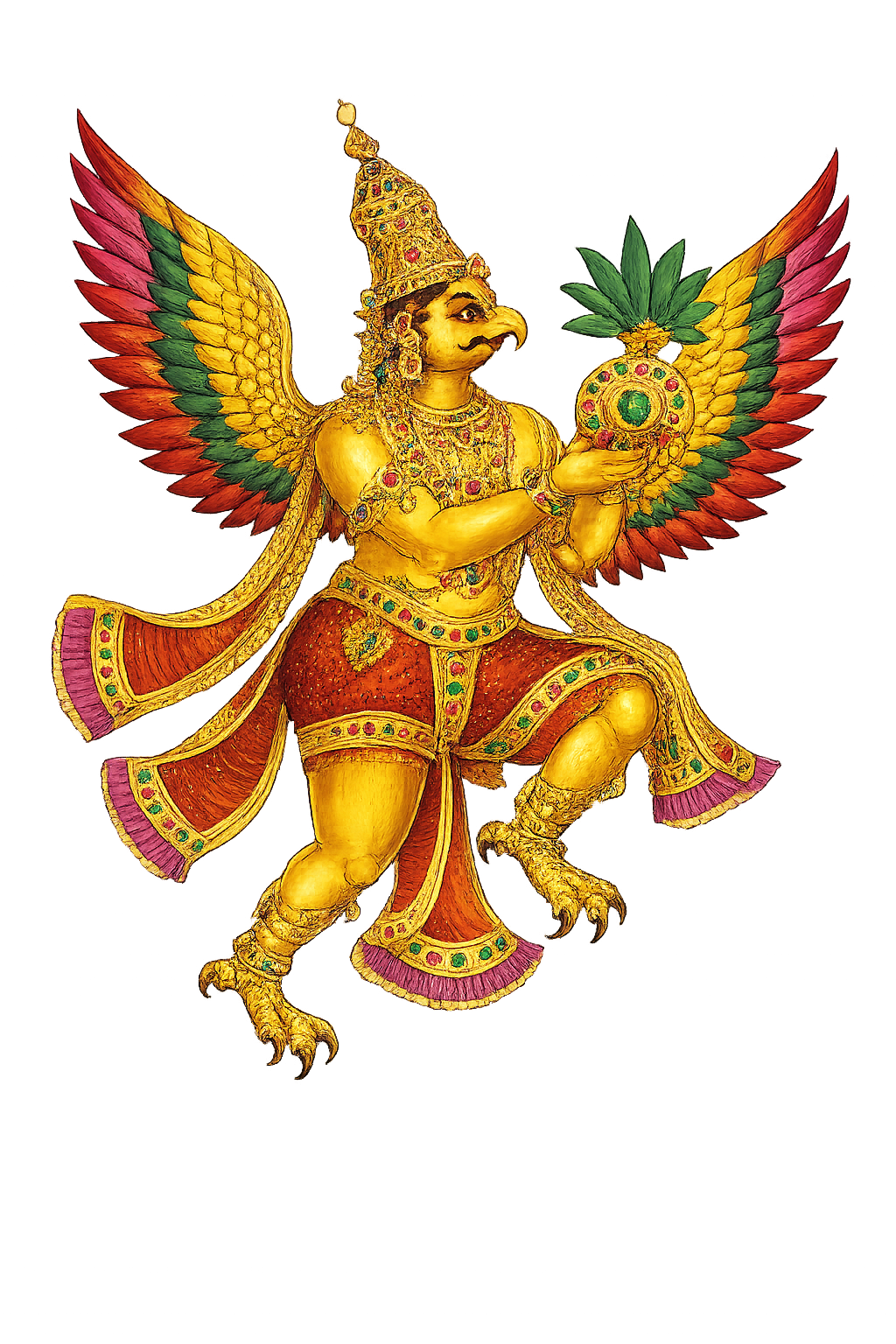
One day, as he wandered through the Malaya mountains with Mitravasu, they stumbled upon a chilling sight—a vast expanse of bones heaped like a mountain. When Jimutavahana inquired about them, Mitravasu explained the tragic fate of the serpents. Mitravasu narrated the tale of how long ago, Kadru, mother of the Nagas, had deceitfully won a wager against Vinata, mother of Garuda, and enslaved her. Though Garuda later rescued his mother, his vengeance against the Nagas remained unquenched. Consumed by fury, he relentlessly hunted and devoured them, prompting Vasuki, the king of the Nagas, to strike a desperate bargain. To prevent the total annihilation of his race, Vasuki agreed to send one Naga daily as an offering to Garuda.
Moved by the tale, Jimutavahana was overcome with grief. He wondered how Vasuki could sacrifice his own subjects rather than offer himself first? How could Garuda, a mighty being sanctified by his service to Krishna, engage in such a cruel act? Deeply troubled, Jimutavahana resolved to end the suffering of the Nagas. He vowed to offer his own body in place of the next Naga sacrifice.
As he pondered his plan, he heard the heart-wrenching cries of a mother lamenting her son's fate. The young Naga, Sankhachuda, was the next offering for Garuda. His mother wept inconsolably, fearing the loss of her only child. Seeing this, Jimutavahana, filled with compassion, stepped forward and assured her:
“I will save your son.”
At first, the mother mistook him for Garuda, crying out in terror. But when she realised his true intent, she called him her son in an even greater sense—for his kindness surpassed all bonds of blood. Despite Sankhachuda's protests, Jimutavahana insisted on taking his place.
With unwavering determination, he ascended the sacrificial rock, waiting for Garuda's arrival. The sky darkened as the mighty bird swooped down, striking him with his beak and carrying him away. Blood dripped from Jimutavahana's wounds, yet he remained serene, offering his body willingly. Even as Garuda devoured him, Jimutavahana prayed:
“May I always sacrifice myself for others in every birth.”
At that moment, Garuda noticed something extraordinary—his prey did not struggle or cry out. Instead, he gazed at him with gratitude. Astonished, Garuda halted, realising this was no ordinary Naga but a being of immense virtue. Just as he questioned him, Sankhachuda arrived, crying out:
“Stop! You have taken the wrong one! I am the Naga meant for you!”
Meanwhile, Jimutavahana's family—his parents and his wife, Malayavati—arrived at the scene, having traced his blood-stained crest jewel. Overcome with sorrow, they mourned his loss. In anguish, Malayavati turned to Goddess Gauri, who had once blessed her with a prophecy of her husband's greatness. She pleaded:
“How could your promise be false?”
Gauri, moved by her devotion, appeared and declared:
“My words are never false.”
She sprinkled divine nectar upon Jimutavahana, restoring him to life, his body unscathed and more radiant than before. The heavens rejoiced, flowers rained down, and celestial drums echoed in the sky.
Humbled, Garuda bowed before Jimutavahana, recognising his unparalleled virtue. He said:
“Ask any boon of me,”
Without hesitation, Jimutavahana replied:
“Cease your slaughter of the Nagas, and restore life to those you have devoured.”
Garuda honoured his wish, reviving the serpents and vowing never to harm them again.
Thus, Jimutavahana's selflessness and courage transformed not only his own destiny but the fate of an entire race. Elevated by Goddess Gauri's blessing, he was crowned Emperor of the Vidyadharas. His tale of sacrifice and compassion remains an eternal beacon of virtue, inscribed in the hearts of gods and mortals alike.
Conclusion
The legend of Garuda weaves together themes of strength, sacrifice, and redemption, transcending mere tales of enmity between eagles and serpents. From his celestial birth and epic battles to his unwavering devotion to his mother and his eventual role as Vishnu's eternal mount, Garuda embodies both might and dharma. His story not only highlights the triumph of will over adversity but also culminates in compassion, as seen in the redemption of the Nagas through the sacrifice of Jimutavahana.
Return to Chapter 5 or back to the Garuda hub.