Assam
Tejeemola
Reading time: 5 to 6 min
Tejeemola is a popular Assamese folktale with the archetypal themes of step-mother and a daughter. It was first published in 1911 by the renowned Assamese author Lakshminath Bezbarua. It was chronicled from the oral tradition to Assamese literature under his collection of short stories ‘Burhi Air Xadhu' (which translates to ‘Old Granny's Tales').
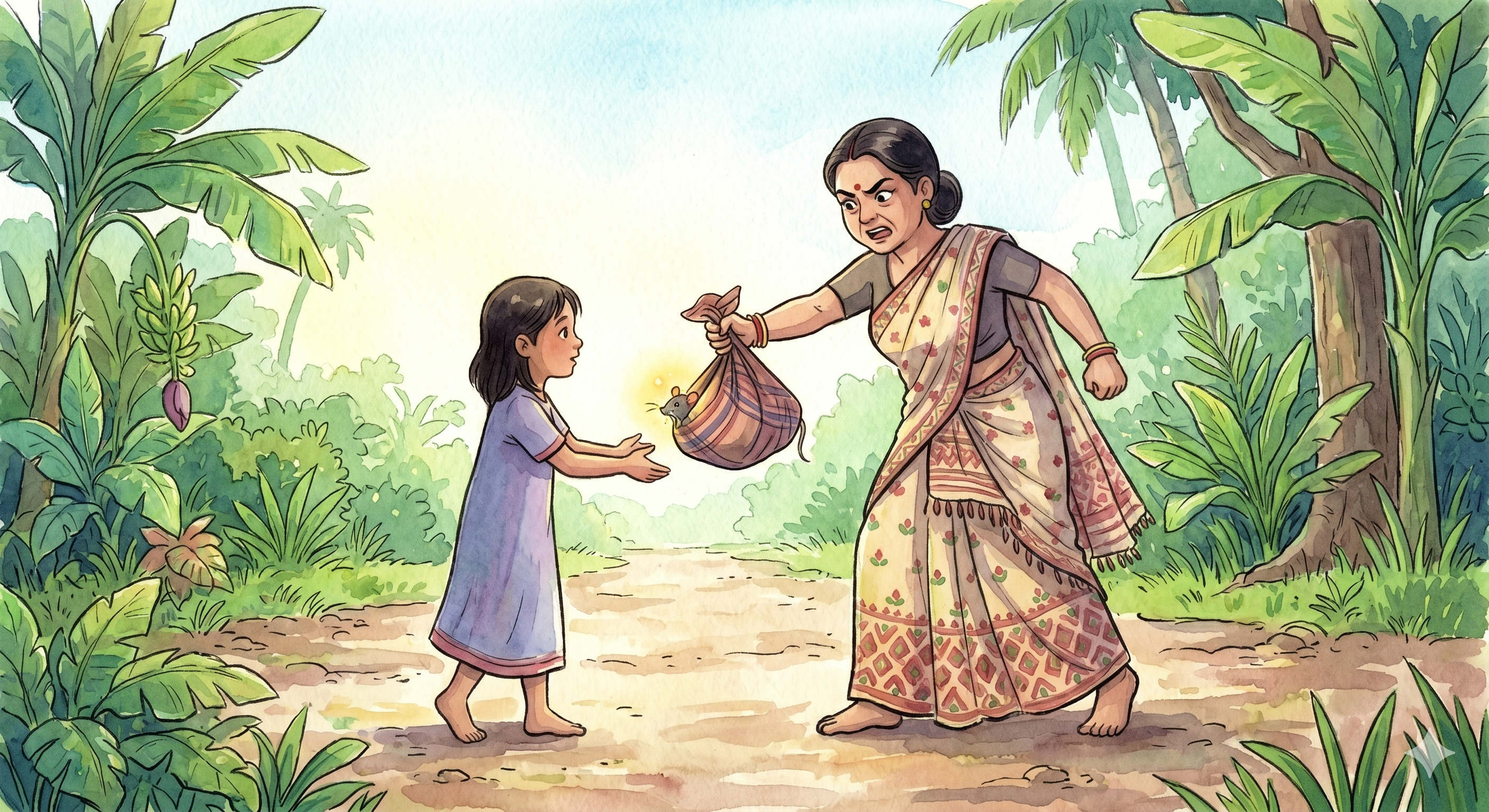
A xaud (merchant) had two wives, and his beloved daughter, Tejeemola, was raised by her jealous stepmother after her mother's death. While the merchant adored Tejeemola, her stepmother, the xaudini (merchant's wife), secretly despised her but cared for her out of fear of her husband.
As Tejeemola grew, her father arranged for her to befriend a girl from a respectable family. Being a trader, he often traveled for long periods. Before leaving on a distant journey, he entrusted Tejeemola to her stepmother, asking her to treat the girl with love and care. However, the stepmother saw this as an opportunity to rid herself of Tejeemola. She planned not only to mistreat her but to ensure she never returned to her father.
Soon, Tejeemola was invited to her friend's wedding and was excited to participate in the festivities. The stepmother pretended to be kind, offering her fine clothes for the occasion. However, she secretly placed a mouse and a burning coal inside the bundle. As Tejeemola neared her friend's house and unwrapped the bundle, the mouse gnawed through the clothes, and the coal burned holes in the fabric. Humiliated and frightened, she burst into tears. The wedding guests consoled her and provided her with new clothes.
Upon returning home, her stepmother feigned outrage over the ruined garments and brutally beat her. Unsatisfied, she dragged Tejeemola to sit near the dhekee (a traditional wooden rice pounder or husk lever) and made Tejeemola push forward the paddy and began to pound it with great force.
She cruelly crushed Tejeemola's hands, feet, and finally her head, which killed her. Without anyone noticing, she dug a pit in the ground just below the eaves of the shed where rice was pounded and buried Tejeemola there.
Days later, a lush gourd plant sprouted from the spot where Tejeemola was buried, bearing beautiful gourds. When a beggar woman tried to pluck a gourd, the plant cried out, revealing Tejeemola's tragic story.
Haatu nemelibi, lau u nisingibi,
Kore mogonia toi,
Pat-kapuror logot mahi aayii xundile,
Tejimola he moi.
Don't extend your hand, don't pluck a pumpkin,
Where have you come from, beggar?
Along with the silk clothes, my stepmother pounded me,
I am only Tejeemola.
Terrified, the woman fled, and upon hearing this, the stepmother immediately destroyed the plant and discarded it in the backyard.
From the discarded plant, a citrus tree grew, full of fruits. When cowherds attempted to pick some, the tree once again wailed Tejeemola's story. Frightened, they informed the stepmother, who realised it was Tejeemola's spirit. Determined to erase all traces, she cut down the tree and threw it into the river.
The tree drifted to a riverbank and transformed into a lotus plant with radiant flowers. When the merchant returned from his travels, he spotted the beautiful lotus and asked a boatman to pluck one for Tejeemola. As the boatman reached out, the flower cried out, revealing Tejeemola's fate. When he told the merchant about the incident, the merchant went near the plant in curiosity. As he stretched out his hand to pluck a flower, it wailed out again:
Haatu nemeliba, phulu nisingiba,
Senehor pitadeu e,
Pat-kapuror logot mahi aayii xundile,
Tejimola he moi.
Don't extend your hand, don't pluck a flower, dear father.
Along with the silk clothes, my stepmother pounded me,
I am only Tejeemola.
Knowing his wife's nature, the father suspected the lotus was Tejeemola. To confirm, he held chewed areca nut in one hand and a sweetmeat in the other, declaring that if it was truly Tejeemola, she would turn into a saalika bird and eat the areca nut. Instantly, the lotus transformed into a bird, flew to him, and ate from his hand, proving her identity. Certain now, he placed the bird in a cage and took her home.
He confronted his wife about Tejeemola's whereabouts. She lied at first but eventually confessed under pressure. The merchant then threw a handkerchief over the bird, and said, "If you are my Tejeemola and if I have love for you, you will turn into a human-being by putting on this handkerchief." The bird transformed back into Tejeemola. The merchant immediately expelled his wife from the house.
From that day, Tejeemola lived happily with her father.